THE CHALLENGE
Radford University’s finance team was drowning in manual, error-prone processes. Relying on an outdated Microsoft Access database and endless Excel files, every ACFR cycle meant weeks of scrambling, late nights, and the constant fear of missing a number. Adjusting entries were spread across 10 different departments, footnotes were manually built in Word, and new GASB standards (87, 88, 94, and 96) were nearly impossible to integrate. Audit points were piling up, and deadlines from the state were set in stone.
As Deana Sentman, Associate VP of Finance & University Controller, put it: “It was horrifically manual. We were trying to hold it all together with too small a team and too many moving parts.”
THE SOLUTION
In 2024, a peer referral from the University of Virginia introduced Radford to Gravity. After a rapid evaluation, the team signed in June and went live by October with Gravity Disclosure Studio, just in time for their state reporting deadline. Gravity’s modern ACFR and GASB solutions replaced the brittle Access build with centralized data, automated footnote and MD&A generation, and built-in validation checks. “They hit every single milestone. The only thing that could have slowed them down was us,” said Sentman.
THE RESULTS
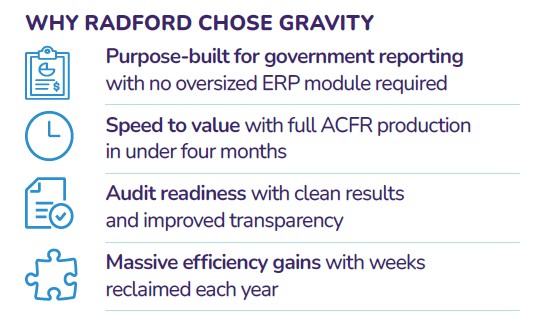
The impact was immediate. Radford eliminated all prior audit points in the first year. Auditors praised the clarity and structure of reports, and the team cut at least two weeks of work from their cycle.
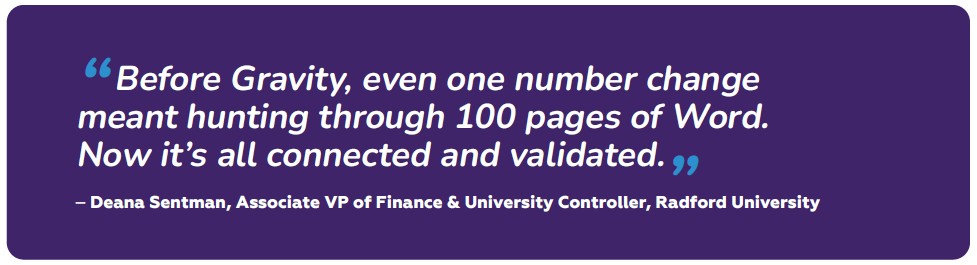
Footnotes that once took days now self-populate, and the MD&A tool automatically identifies top changes, saving hours of analysis. “It took painful, error-filled procedures and created a seamless process. I finally had confidence that every number connected,” said Sentman.
LOOKING AHEAD
With renewals confirmed, Radford is exploring automation for NCAA reporting, future GASB changes, and potential budgeting solutions.
“Gravity was exactly what we needed with great pricing, excellent support, and a team that listens,”
Sentman noted.