
Gravity + ClearGov: We've joined forces to create the public sector's first end-to-end modern platform.
Learn MoreDiscover how local governments are cutting months of manual work down to days.
ACFR modernization is the shift from spreadsheets, Word documents, and consultants to software that connects your financial data directly to your published reports. Instead of spending months copying numbers between disconnected files, finance teams update data once and watch it flow everywhere automatically.
The result: audit-ready Annual Comprehensive Financial Reports in days, not months.
Gravity’s Disclosure Studio was built specifically for this shift.
“Most finance teams don’t have a reporting problem. They have a data connection problem. Somewhere between the source and the final PDF, everything falls apart. ACFR modernization is about eliminating that gap.”
— Tyler Davey, CEO, Gravity
For most local government finance teams, the ACFR process looks something like this: Pull numbers from the ERP. Paste them into Excel. Build schedules. Write narratives in Word. Send everything to a designer for layout. Wait. Get revisions back. Find errors. Fix them. Repeat until the deadline forces you to stop. It works. Barely.
But modernization changes the underlying structure. Your financial data lives in one place. Tables, schedules, and narratives pull from that single source. When a number changes, every reference to that number updates automatically. Formatting and compliance requirements are built into the templates from the start.
Take for example the City of Columbus. They used to spend two weeks preparing their ACFR. After modernizing with Gravity, that dropped
to one day. Not because their team got faster at copying and pasting. Because they stopped copying and pasting altogether.
From shrinking talent pools and government finance talent retention efforts, to new FDTA legislation and shifting GASB standards, multiple forces are pushing government finance teams toward modernization faster than ever.

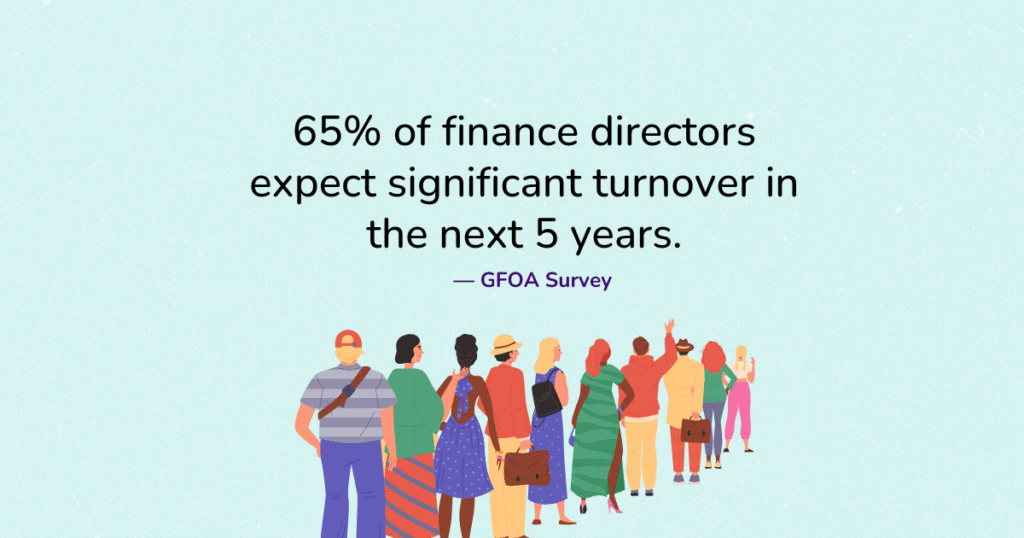
Finance departments are shrinking. Retirements are accelerating. And the people who leave take decades of institutional knowledge with them. A 2023 GFOA survey found that 65% of government finance directors expect significant turnover in the next five years. Many already operate with skeleton crews.
The ACFR process that worked when you had six people on staff doesn't work when you have three.

The Financial Data Transparency Act passed in 2022 with bipartisan support. By 2027, municipal bond issuers will need to submit financial data to EMMA in machine-readable formats. Your current ACFR is a PDF. It's designed for humans to read. Governments that modernize now will have structured data ready to export.
Governments still running on Excel will face a scramble when the deadline arrives.

GASB keeps publishing new standards. GASB 87 changed lease accounting. GASB 96 added subscription-based IT arrangements. More changes are on the way. Each new standard means new disclosures, new calculations, and new places to make mistakes.
Modern ACFR software builds compliance into the templates. Your team focuses on the data, not on interpreting accounting pronouncements.

A University of Hawaii study found that nearly 90% of spreadsheets contain errors.
Think about how many linked spreadsheets go into your ACFR. Each tab, each formula, each cell reference is a place where something can break. A mistyped number, formulas that points to the wrong cell, a copy that didn’t paste correctly, or versions that don’t save.
Manual workflows create fragility. The more steps, the more opportunities for error. GFOA recommends strengthening internal controls to catch these mistakes. Good advice. But internal controls catch errors after they happen.
When financial data links directly to your report, there’s no copy-paste to get wrong. When tables update automatically from source data, there’s no formula to break. When version control is built into the system, there’s no confusion on which version is final.
For more on this topic, read: To Err Is Human, but your ACFR cannot afford it
Some of these will sound familiar to organizations in need of ACFR modernization:

If 40% of your ACFR effort goes into making things look right rather than making sure things are right, the balance is off

Multiple people editing multiple files across multiple weeks creates chaos. "Which version has the auditor's changes?" shouldn't be a question you ask at 10 PM before a deadline.

Last year's ACFR should be a foundation, not a starting point. Rolling forward should take minutes, not days.

If someone's vacation would derail the process, that's a risk. If someone's retirement would cause a crisis, that's a bigger risk.

Some pressure is unavoidable. Finance work has hard deadlines. But chaos is optional. The difference is whether your process is connected and predictable or fragmented and reactive.
Not all ACFR software is the same. Here’s what actually matters.
This is the foundation everything else builds on. A universal data model organizes all your financial data in one structure: funds, departments, time periods, account codes. Update a number once and it flows to every schedule, table, and narrative that references it.
The alternative is what you have now: the same number typed into twelve different places, with twelve opportunities to type it wrong.
Gravity calls this the MDFM (Multi-Dimensional Financial Model). Other vendors have their own approaches. What matters is whether the system treats your data as connected or as separate pieces you have to manually reconcile.
Corporate financial reporting tools exist. They’re built for 10-Ks and quarterly earnings reports. They don’t understand fund accounting. They don’t know what GASB requires. They treat government finance as a special case to be adapted for, not designed around.
Government-specific software comes with templates built for your requirements: GASB 87, 88, 96. GFOA award criteria. ADA accessibility standards. The compliance requirements are baked in, not bolted on.
ACFR modernization software uses AI for practical tasks, not gimmicks.
Gravity’s AI Importer reads your prior-year ACFR and builds your report structure automatically. Instead of spending weeks recreating tables and schedules, you upload last year’s document and start with a framework in place.
The GFOA AI Checklist validates your report against award criteria in real time. It catches missing sections and incomplete disclosures before you submit, not after your application gets rejected.
These aren’t experimental features. They’re production tools that speed up implementation and reduce risk.
Your ERP manages transactions. ACFR software manages reporting. They serve different purposes.
Good ACFR software integrates with whatever financial system you have: Tyler, Oracle, SAP, or even spreadsheets. It pulls data from your existing sources without requiring you to abandon them.
“ERP-agnostic” isn’t just a nice feature. It’s what makes implementation practical. Rip-and-replace projects fail. Incremental improvements succeed.
Read more: How to Modernize Government Financial Reporting and Keep Your ERP
ACFR modernization is the starting point, not the finish line.
The same principles that streamline your Annual Comprehensive Financial Report apply to everything else you publish: Budget Books, PAFRs, CIP reports, monthly financials.
When all your reports pull from the same data model, consistency stops being a goal you chase and becomes a default you start with. Your Popular Annual Financial Report summarizes your ACFR because it’s connected to your ACFR, not because someone manually extracted the highlights.
Placer County, California was already using Gravity for its 500+ page Budget Book when they decided to bring their ACFR onto the same platform. Before that, their ACFR lived in disconnected Word and Excel files — MD&A, financial statements, footnotes, and statistical sections all managed separately. Version control and formatting consumed 30% of their time. After consolidating everything in Gravity, they cut manual prep time by 25-35%.
“It wasn’t just time consuming. It was stressful,” said Debbie Chan, Financial Reporting Manager. “One small change could impact multiple documents.”
That’s what modern reporting looks like: not just faster ACFRs, but a connected system where every report builds on the same foundation.
The old implementation model took 3-6 months. Consultants flew in. Your team spent weeks in training. Templates were built from scratch. By the time you went live, you were exhausted before ACFR season even started.
Modern implementation works differently.

Upload your prior-year ACFR. The AI Importer analyzes the document structure, identifies tables and schedules, and creates your starting framework. What used to take weeks of manual template building happens in minutes. You still review and refine. The AI gives you a foundation, not a finished product. But starting at 80% complete is very different from starting at zero.

Gravity customers typically go live within their first reporting cycle. Not because implementation is trivial, but because the system is designed to work with your existing process rather than requiring you to rebuild everything before you start. Park City School District went from 30-minute tax updates to 5-minute tax updates. That efficiency gain started showing up immediately, not after a six-month rollout.

With ACFR modernization, the results are significant: Spend less time on data entry and formatting. More time on review and analysis. Structured workflows that don't depend on memorized procedures. New staff can follow the process because the process is visible in the system. Collaboration without email attachments. Everyone works from the same data. Comments and changes are tracked automatically.
Finance directors don’t buy software for fun. Here’s how to think about the return.
Columbus, Ohio: ACFR preparation dropped from two weeks to one day.
Park City School District: Tax updates dropped from 30 minutes to 5 minutes.
These aren’t marketing claims. They’re reported outcomes from finance teams using the software.
With ACFR modernization, the time savings compound. If your ACFR takes 20% less effort, that’s 20% capacity you get back for other work. Multiply that across Budget Books, PAFRs, quarterly reports, and council presentations.
Consultant fees run $50,000 to $200,000+ per year for governments that outsource ACFR expertise. Collier County, Florida eliminated their consultant dependency entirely. The software subscription costs less than one year of consulting fees, and the knowledge stays in-house.
Designer fees add up too. When your team can publish professional documents directly, that expense disappears.
Fewer manual steps means fewer errors. Built-in compliance validation catches problems before audit. Audit trails show exactly who changed what and when.
And when someone leaves, the process doesn’t leave with them. The system preserves institutional knowledge automatically.
GFOA awards signal excellence to councils, citizens, and bond rating agencies. The Town of Palm Beach achieved the GFOA Triple Crown: Certificate of Achievement for Excellence in Financial Reporting, Distinguished Budget Presentation Award, and Award for Outstanding Achievement in Popular Annual Financial Reporting.
Read the case study: Town of Palm Beach: GFOA Triple Crown
The Financial Data Transparency Act requires machine-readable financial data for municipal securities disclosures by 2027. Your current ACFR is a PDF designed for humans. FDTA requires structured data that computers can parse and compare across thousands of governments.
Most governments aren’t thinking about this yet. The requirements aren’t finalized and 2027 feels far away. But if you’re evaluating ACFR software anyway, FDTA readiness should be part of the conversation.
PDF won’t work. Machine-readable means tagged data fields, standardized formats, and exports that software can process without human interpretation. Think structured XML or XBRL, not scanned documents.
Choose ACFR software that stores your financial data in a structured database, not just formatted documents. When your data lives in tagged fields tied to standard account codes, exporting in FDTA-compliant formats becomes a configuration option rather than a rebuild.
Gravity’s Universal Data Model does exactly this. Your ACFR content is stored as structured, connected data from day one. When FDTA requirements are finalized, the export format changes. Your workflow doesn’t.
Governments that modernize now will have a clear path to compliance. Those still assembling ACFRs in Word and Excel will face a much harder transition when the deadline arrives.
Yes. But, the process that worked with a full staff doesn't work with a skeleton crew. What worked before GASB 87 needs updating. And what worked before remote work assumed everyone was in the same building.
If your team can use Excel, they can use modern ACFR software. Gravity Disclosure Studio is built for finance professionals, not IT departments.
You don't have to. ACFR software integrates with Tyler, Oracle, SAP, and others. It fills the gap between your transaction system and your published reports. No rip-and-replace required.
The AI Importer builds your report structure from your prior-year document. That's not a months-long project. It's an afternoon of setup followed by refinement during your normal workflow.
The governments winning GFOA awards and finishing ACFR season on
time have already made this shift. They’re not working harder.
They’re working from connected data.
See how Gravity’s Disclosure Studio can modernize your ACFR process.
ACFR automation uses software to connect your financial data directly to your published reports. Instead of manually copying numbers between spreadsheets, Word documents, and design files, you update data in one place and it flows everywhere automatically. The result: faster reports with fewer errors.
With AI-assisted setup, most governments go live within their first reporting cycle. Upload your prior-year ACFR, let the AI Importer build your structure, then refine during your normal workflow. Days to weeks, not months.
Yes. Modern ACFR software is ERP-agnostic. It integrates with Tyler, Oracle, SAP, and other financial systems. The software pulls data from your existing sources without requiring you to replace them.
It removes barriers. Built-in GFOA compliance validation catches missing elements before submission. Award-ready templates ensure proper formatting. But the content still needs to be excellent. The software handles mechanics so your team can focus on substance.
The ACFR (Annual Comprehensive Financial Report) is your complete, audited financial statement. The PAFR (Popular Annual Financial Report) is a citizen-friendly summary. Modern software connects them, so your PAFR automatically reflects your ACFR data.
Pricing varies by government size and scope. But consider the comparison: consultant fees run $50,000-$200,000+ annually, and that expense repeats every year without building internal capability. Software costs less and the knowledge stays in-house.
Yes. Gravity maintains SOC 1, SOC 2, and TX-RAMP security certifications. That's the standard required for banking and healthcare. Cloud security has advanced significantly in the past decade.
Start with software that stores data in structured formats. Machine-readable exports will be a configuration option, not a major project. Governments modernizing now will have a straightforward path to compliance. Those waiting will face a harder transition.