
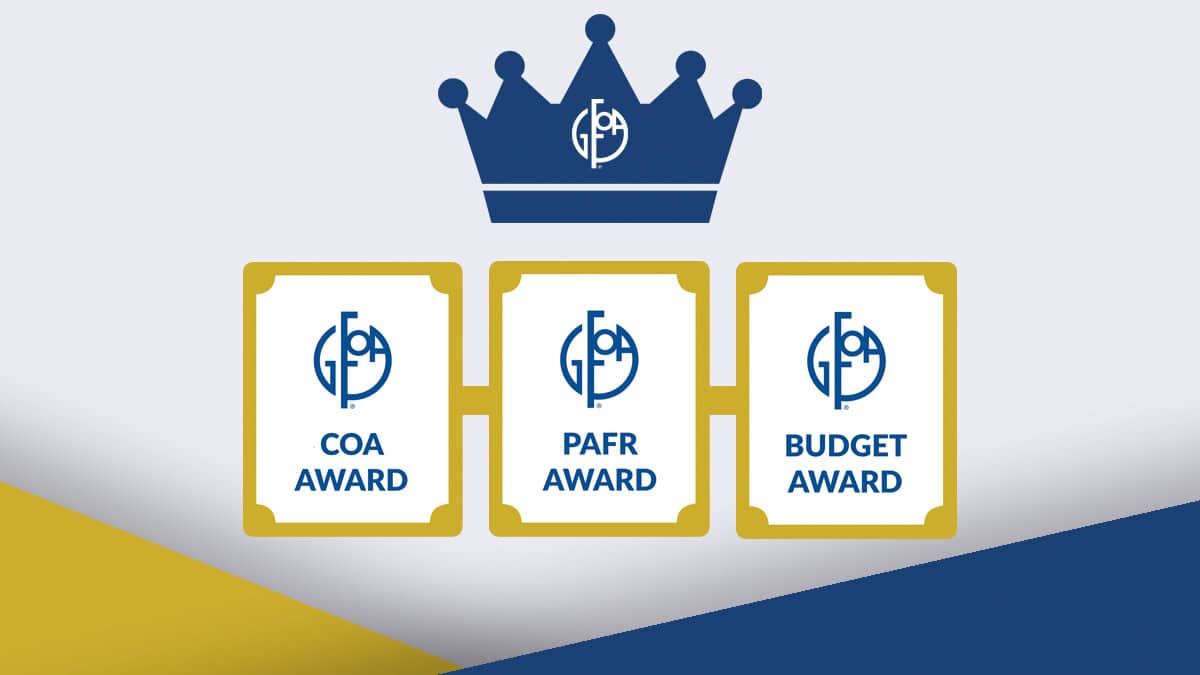
For government finance professionals, the GFOA Triple Crown is the pinnacle of excellence, recognition that your team has mastered every dimension of financial communication and accountability.
Yet, fewer than 300 local governments out of 90,000 nationwide achieve all three GFOA awards each year. That’s just 0.3%.
It’s the kind of accomplishment that defines careers, elevates finance departments, and signals to citizens, councils, and auditors alike that your organization operates at the highest standard. When your budget document, ACFR, and citizen report all meet GFOA criteria, you’re not just checking boxes. You’re demonstrating financial excellence is embedded in how your team works.
So why does it remain so rare?
If you’re spending 12-hour days for three months during reporting season, constantly chasing the “right version” of spreadsheets, or watching your team burn out during what should be a predictable cycle, you’re experiencing exactly why the Triple Crown stays elusive.
What is the GFOA Triple Crown?
The GFOA Triple Crown represents excellence across three critical areas of government financial management:
- Distinguished Budget Presentation Award: Recognizes comprehensive budget documents that meet rigorous criteria for policy, financial planning, and organizational communication
- Certificate of Achievement for Excellence in Financial Reporting: The standard for transparent, comprehensive Annual Comprehensive Financial Reports (ACFRs)
- Award for Outstanding Achievement in Popular Annual Financial Reporting: Honors governments that produce citizen-friendly financial reports (PAFRs) that make complex financial data accessible to the public
Together, these awards signal that a government has mastered both the technical rigor and public transparency that modern accountability demands.
The Challenges of Winning a GFOA Triple Crown
The rarity of the Triple Crown isn’t due to lack of ambition. Every finance director we speak with wants GFOA recognition. The barriers are brutally operational.
The Time Trap
Most finance teams spend 60 to 90 days just on the ACFR—and that’s if everything goes smoothly. During reporting season, teams routinely work 12-hour days for three months straight, missing family dinners and sacrificing weekends.
One finance professional described it plainly: “During their ACFR or budget season, they’ll be in office for 12 hours a day for three months and not see their families. And even then it still ends up being a horrible output.”
When your entire bandwidth is consumed by just getting required reports out the door, there’s simply no capacity left for creating a PAFR or elevating your budget presentation to award-winning standards.
The Version Control Nightmare
“The biggest challenge had to be the back and forth—never knowing what’s changed or what needs to be updated,” says Melissa Ladd, Controller for the Town of Palm Beach. “Not knowing which one was the right one to be using.”
Teams juggle disconnected spreadsheets, Word documents, and formatting tools. Every data change ripples across multiple documents. You update a number in your budget schedule, but did you remember to update it in the transmittal letter? The footnotes? The executive summary? The supplemental schedules?
It’s exhausting, error-prone, and it’s where finance turns into a nightmare.
The Compliance Complexity
GASB requirements evolve continuously. ADA compliance standards are tightening—and the stakes are rising fast. In Florida, attorneys are actively hunting for ADA non-compliant financial documents and filing million-dollar lawsuits against cities that publish inaccessible PDFs.
As one sales director told us: “You have those troll lawyers that will actually go and look for cities that aren’t in compliance and then have a huge lawsuit that’ll be millions of taxpayer dollars just going down the drain.”
FDTA preparation looms on the horizon. For lean teams already stretched thin, keeping pace with regulatory changes while maintaining award-quality documentation feels impossible.
The Institutional Knowledge Crisis
Government finance teams face relentless workforce pressure, such as retirements, private sector poaching, and burnout. When your processes live in people’s heads rather than systematic workflows, each departure sets you back months.
New hires walk into a maze of tribal knowledge: “Sarah knows how to format the debt schedule, but she’s retiring next month. Tom handles the pension footnotes, but he just left for a private sector job. The budget book template is somewhere in the shared drive, but nobody’s sure which version is current.”
The Hidden Costs of Status Quo
Beyond the obvious struggle, the financial and career costs of manual processes are staggering:
Personal Toll
Three months of 12-hour days isn’t sustainable. It’s not what you signed up for when you entered public service. The work-life balance that’s supposed to be government’s compensation for lower salaries? Gone during reporting season.
Financial Risk
Some governments don’t realize that late ACFR submissions can directly impact bond ratings. That is a significant set-back — one that is directly on you for not getting it done.
Legal Exposure
ADA compliance isn’t optional anymore. The lawsuit risk is real and growing, particularly in states where legal firms have made government document compliance a specialty practice. One lawsuit can cost more than a decade of proper tools.
Why the Triple Crown More Is More Important Than Ever:
Three converging forces are elevating the importance of comprehensive financial excellence:
Rising Transparency Expectations
Citizens and oversight bodies expect more than minimum compliance. Your neighbor city just published an interactive PAFR. Council members compare your reporting to best-in-class examples they find online. The bar for “good enough” keeps rising.
Columbus, Ohio didn’t just produce compliant financial reports—they became the first city in Ohio to submit their ACFR every year. That’s a competitive advantage that other cities notice and aspire to match. (Read more about our work with Columbus here).
The Efficiency Imperative
“Do more with less” isn’t a slogan—it’s the operational reality. Federal funding that temporarily boosted capacity is receding. DOGE-style efficiency initiatives are spreading to state and local levels. The teams that thrive are finding ways to deliver excellence without proportionally expanding headcount.
The Platformization Movement
Governments are exhausted by vendor sprawl. Managing disconnected point solutions for budgeting, reporting, transparency, and compliance creates its own overhead. Progressive finance teams are consolidating tools to reduce complexity while expanding capability.
Best Practices For Winning the GFOA Triple Crown
After working with governments across 43 states managing over $310 billion in budgets, we’ve identified patterns that separate achievers from aspirants:
1. Establish a Single Source of Truth
Triple Crown winners don’t chase versions across multiple spreadsheets. They establish one unified system where budget data, actuals, projections, and historical information live together. When you update a number once, it automatically populates everywhere—in your budget book, ACFR schedules, and PAFR summaries.
“We’re used to changing one number in five different documents,” says Melissa Ladd, Palm Beach’s Controller. “So, when you enter it once and it populates everywhere? It’s hard to believe it actually works—but it does.”
The Town of Palm Beach cut production time from 90 days to 6 weeks in their first year—and that was just the beginning.
2. Automate the Formatting Burden
Award-winning documents require consistent, professional formatting across hundreds of pages. But manual formatting is where teams lose weeks, adjusting margins, fixing page breaks, ensuring tables align, verifying footnote references.
When customers talk about wanting “automation,” they’re not asking for speed for speed’s sake. They’re asking for readiness, accuracy, and transparency. They want to trust that when they make one change, everything connected to it updates correctly. They want ADA compliance built in, not bolted on at the end when it’s too late.
Governments that achieve the Triple Crown use purpose-built templates designed specifically for GASB requirements and GFOA standards. This isn’t about making documents “look pretty”—it’s about embedding compliance and best practices into the structure so your team focuses on analysis rather than formatting fires.
3. Build Collaborative Workflows That Survive Turnover
Complex documents require coordination across departments, reviews from multiple stakeholders, and clear audit trails. Teams still using email attachments and “Track Changes” inevitably hit version control chaos.
Effective workflow systems provide clear status tracking, role-based permissions, and organized collaboration. When processes live in the system rather than in people’s heads, new staff can pick up exactly where others left off—even mid-cycle.
4. Make Time for Strategic Work
Here’s the paradox: You can’t produce a PAFR if you’re drowning in ACFR production.
Palm Beach wanted to create a citizen-facing financial report for over 20 years but never had the bandwidth—until they cut their production time by 40%. That freed capacity wasn’t just about working faster. It was about automating the repetitive work so their small team could finally pursue the strategic initiatives that earn recognition.
The result? Their first-ever GFOA Triple Crown—a feat accomplished by less than 1% of local governments.
(Read the full story behind Palm Beach’s GFOA Triple Crown victory here.)
5. Design for Sustainability, Not Heroics
One-time heroics don’t lead to consistent excellence. Triple Crown sustainability requires processes that survive staff turnover, accommodate evolving compliance requirements, and actually get easier year over year.
This means your institutional knowledge lives in the system, not just in people’s heads. Roll-forward capabilities let you build on prior years rather than starting from scratch. When Sarah retires or Tom leaves for the private sector, the next person can step in without months of knowledge transfer.
The Implementation Reality
Let’s address the elephant in the room: implementation fear is legitimate.
When software dictates process rather than adapting to your proven workflows, implementation becomes disruption. Teams end up back in Excel after wasting hundreds of thousands of dollars and three years of political capital.
The finance directors who successfully transform their operations take a different approach: start where the pain is worst, prove the value quickly, then expand.
Most teams begin with their highest-pain process—often the ACFR production cycle or budget book creation. Get one win. Show Council the improved timeline and quality. Build confidence. Then tackle the next challenge.
This modular approach delivers quick wins while building toward comprehensive platform benefits—without the risk of a failed big-bang implementation.
When Palm Beach transformed their operations, their Town Council “had no idea we changed software” because the transition was so smooth. The finance team adapted their new tools to fit their existing process, not the other way around.
Measuring Success Beyond Awards
While GFOA recognition is the visible achievement, the underlying operational improvements deliver value regardless of award status:
- Reclaim your life: Reporting season shouldn’t mean three months of 12-hour days
- Protect your bond rating: Consistent, on-time submissions signal financial health to rating agencies
- Eliminate legal exposure: Built-in ADA compliance protects against costly lawsuits
- Survive turnover: New team members get up to speed in weeks, not months
- Attract better talent: Modern tools help recruit skilled professionals who have options
- Create strategic capacity: Finally have time for the high-value work you’ve been putting off for years
These outcomes matter whether you’re pursuing all three awards or simply trying to make reporting season survivable.
Getting Started
The gap between where most teams are today and Triple Crown achievement isn’t primarily about budget or staffing levels. It’s about operational approach.
Ask yourself:
- Are you working 12-hour days during reporting season—and is that sustainable?
- How many versions of your budget spreadsheet exist right now?
- What happens when your most experienced team member retires next year?
- Could you publish a PAFR with your current bandwidth, or is all your capacity consumed by required reporting?
- If you publish a non-ADA-compliant document tomorrow, what’s your legal exposure?
- Is it time to start looking at ACFR modernization?
If these questions make you uncomfortable, you’re not alone.
But the GFOA Triple Crown isn’t about working harder; it’s about working smarter with systems purpose-built for government financial operations. With the right foundation, even lean teams can achieve award-winning results while reclaiming their work-life balance.
Because you didn’t enter public service to spend three months every year buried in spreadsheets. You came here to serve your community.
And that should include serving them with professional, transparent, award-worthy financial communications.
What if your next ACFR took days instead of weeks? Explore how Gravity’s purpose-built automation eliminates the manual grind without sacrificing award-ready quality. Learn more.